Childhood Nutrition Education: Investing Early Can Pay Healthy Dividends for a Lifetime

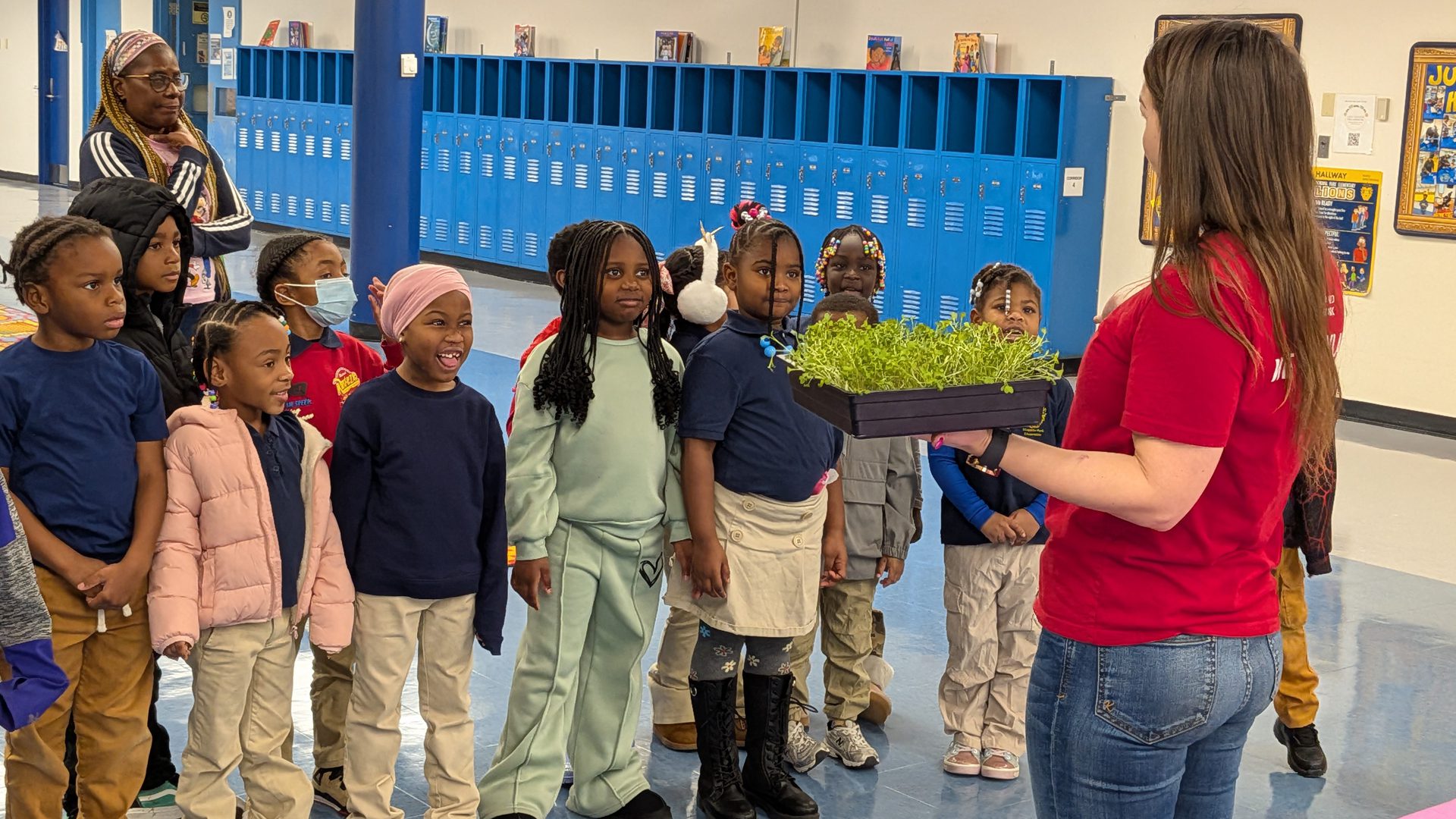
While the Maryland Food Bank distributes tens of millions of meals annually to neighbors of all ages, helping young Marylanders develop and maintain a positive relationship with healthy food is some of the most important work we do.
The earlier we can reach neighbors, the better chance they have of thriving for a lifetime.
That’s why we focus on childhood nutrition education, both at the Maryland Food Bank—with our Education & Demonstration Garden—but also through community outreach, where we bring the garden (and fun!) to local schools.
Ashlie Church, who serves as the food bank’s Nutrition Specialist, partners with local schools and organizations on these workshops, and has seen their potential firsthand. She shared one particularly memorable interaction with one of our youngest neighbors, three-year-old Ava who attends Baltimore Montessori Public Charter School.
“Ava was really excited to share with me that she has a garden at home, and that she and her grandmother grow tomatoes, slice them up, put them on bread, and they have a little tomato sandwich together,” Ashlie said. “That was a really cute little story that felt very connected to what I was talking about with the garden, and the tomatoes, and obviously felt very personal to her. That was very encouraging to me!”
Since the program’s launch in winter 2024, Ashlie has hosted more than 100 events statewide, including a recent event with the Judy Center at Moravia Park Elementary School.
Doing More at Moravia Park Elementary
In northwest Baltimore, the Judy Center has been operating at Moravia Park Elementary School for 25 years.
A longtime food bank partner, the Judy Center offers monthly distributions of nutritious food and connections to benefits like the Supplemental Nutrition Assistance Program (SNAP); as well as critical supports like parent workshops, diaper distributions, and family and child play groups to foster early learning.
Nicole Wood, the Center’s coordinator, is very excited about the potential of nutrition education, and what it can do for her community.
“We just love to support families and children, and are always looking for new community partnerships, so the opportunity to participate in nutrition and gardening workshops and teach young children is very much appreciated by the school and the community,” she shared.
Keeping it Real, Keeping it Fun
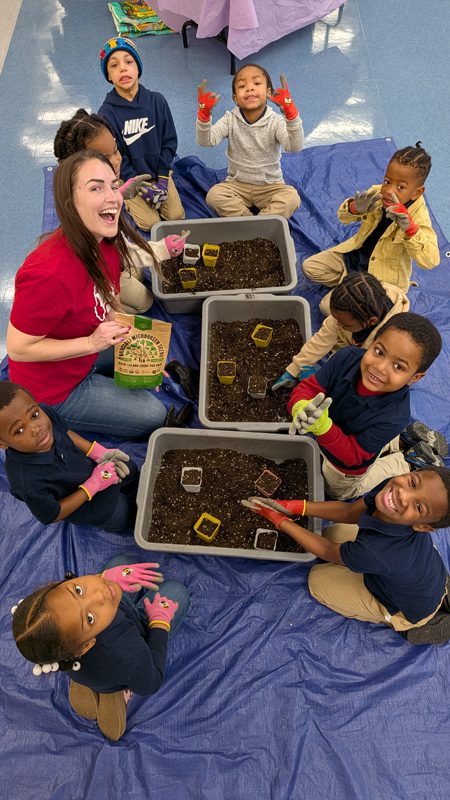
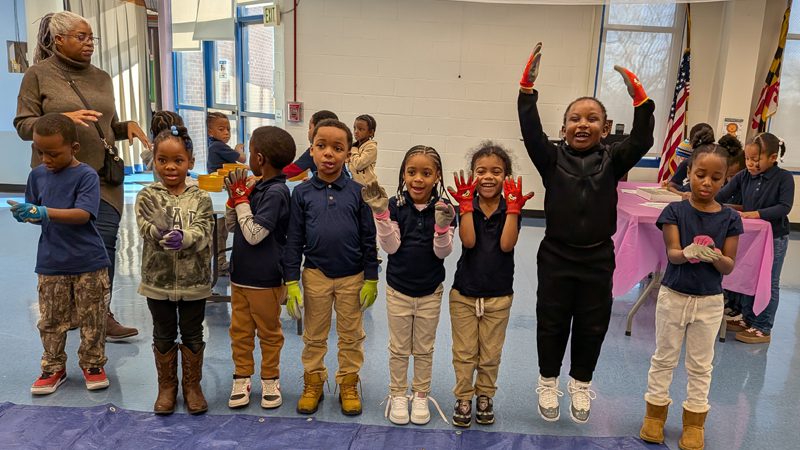
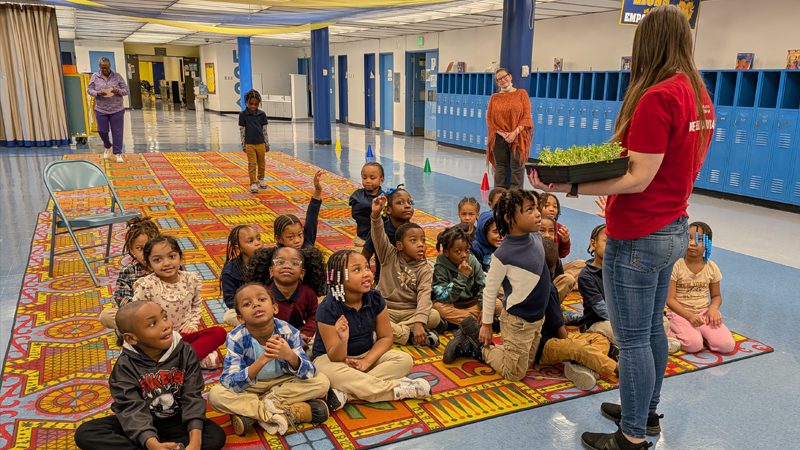
In each 30 minute workshop designed for younger audiences, Ashlie engages kids with three hands-on activities: planting microgreen seeds in a take-home pot (which helps kids make that “where does food come from?” connection), sorting foam produce either by color or into fruits and vegetables (which helps kids understand the variety of choices available to them); and coloring “My Plate” sheets (to help them begin understand how many of their choices are appropriate to eat at a single meal).
While Ashlie brings all the seeds, soil, materials, and everything that’s needed for the workshop at no cost to the school, sites do need to have a space where an 8’x8’ tarp can be laid out for the planting activity.
Some workshops have taken place in outdoor spaces such as playground areas and school or community gardens, but Ashlie has hosted several indoor workshops, like the one at Moravia Park.
“While it’s always nice for the kids to be outside, I am able to set up the tarps in a classroom too. Teachers have been very helpful, moving desks and tables to the side, but we’re very flexible, and will work with the school to make sure the kids have a great workshop regardless of location,” said Ashlie.
“I think there should be more broccoli because it’s my favorite food!”
The Wisdom of Children
When it comes to food, kids are generally not shy about expressing their likes, and definitely not shy about expressing their dislikes, and the students at Moravia Park were no different.
Throughout the five sessions Ashlie hosted, several kids were elated to offer their perspectives on nutrition education, gardening, healthy foods, and much more.
In the beginning, while Ashlie was explaining that the food bank has a garden in Baltimore, six-year-old Adonis (who was also a fan of choosing foods by color), patiently kept his hand in the air until he was called on.
“I think you should grow lemons, corn, and onions at the food bank!”
Other kids added their voices to the chorus, shouting “apple trees,” “oranges,” “carrots,” and a cornucopia of other fruits and veggies.
Later, during the sorting activity, a young girl named Royalty (who chose to sort by her favorite color, green) proudly held up a bunch of broccoli and loudly shared, “I think there should be more broccoli because it’s my favorite food!” When asked why she thought it was important to eat fruits and vegetables, she flexed her arm and through a big grin proclaimed, “so you can become STRONG!”
Getting Together for the Greater Good
Following collaboration with the Regional Program Directors—the staff members who work directly with our community partners and know them best—Ashlie proactively reaches out to school site coordinators.
“I communicate directly with the coordinators to see what works best for them, what age groups they’re interested in having workshops for, and we schedule a date together. I come out and bring everything that’s necessary to give the workshop!” she shared.
Designed to be adaptable to multiple age groups, nutrition education workshops are a great activity for kids from pre-K through young adulthood.
“The younger kids want to tell me about things they’ve seen growing, that fruits and veggies are good, healthy, and can make them big and strong, which is great; but there’s a little more depth of knowledge that they can learn as they go on through elementary school, high school, and into early adulthood, and we want to support them at every stage,” said Ashlie.
Connecting with the Maryland Food Bank about Nutrition Education couldn’t be easier.
Our Nutrition team is ready to help schedule a time for your class or organization to visit the Education & Demonstration Garden here at our Halethorpe headquarters, or bring a workshop to your school.

About The Author
Ben Gross
For more than 30 years, Ben has been helping organizations raise awareness and inspire action by creating compelling narratives. And since 2018, Ben has been the Maryland Food Bank's Staff Writer, elevating the voices of food-insecure neighbors to further the Maryland Food Bank's mission of feeding people, strengthening communities, and ending hunger for more Marylanders.
Get updates on our progress in the fight against hunger
Want to see how your involvement directly impacts the well-being of your neighbors in need? Get the latest news sent to your inbox.